Wednesday, August 31, 2011

Webcomic Wednesday: Job Hunting

For those who don't have some amazing super vision, you can either click the picture to read the text or read it below:

August 30th, 2011

The job hunt is tiresome. The wild openandwellpaidjob is rare and elusive, hiding among the jobyouwantbutisfilled or camouflaging itself as a winged unpaidinternship. One must approach the jobs with caution for if you think one might be within reach, it can vanish in an instant, leaving no hint of where it's gone.

I've heard spotty reports of mass gatherings of openandwellpaidjobs in certain places around the wide world. The jobs can be found posting themselves at these sites, as if waiting to be found. After exploring these options, I've concluded that there are simply so many hunters, one is lucky to even get a chance shot at the jobs.

But I continue stalking my prey, leaving baited resume traps and making job mating calls to draw the creature closer. My supplies should last me for the time being but the search for the openandwellpaidjob becomes more desperate by the day...

Tuesday, August 23, 2011

Webcomic: Poetic Umemployment

Occasionally words cannot contain the babbling going on inside my head so I'm going to throw in a webcomic every now and again. And so without further ado, my premiere attempt at the world of webcomics: Poetic Umemployment.
And hey, I'm new to this so if you've got thoughts, comments, criticisms... whatever. Please feel free to let me know in the comments!

Tuesday, August 16, 2011

Gravity is God and Albert Einstein was a Prophet

For as long as we've been around (roughly 5771 years), we've been asking the question: what is god? Now, I'm fairly confident in what I can say that god is not. God is not a dude in the sky with a white beard and a robe. God is not constantly watching us and judging us, putting us in a book under naughty or nice.

What I do feel that I know is that god is something that the human mind is incapable of comprehending. God is something beyond this plane of existence but peeking through into perceivable space. Confused yet? Just stay with me cause it makes more sense in a bit.

God is gravity. We are god. The planet is god. The same way that all of our cells somehow manage to work together and make us live, by some bizarre bit of chance, us being hear makes god "live". But just as those cells don't know how the whole body functions, we don't know everything about how the universe works. The mysteries of the universe: dark matter, black holes, gravity; these are the very definition of mystical forces.

Gravity is the force that binds everything together in the universe. Without gravity the galaxy doesn't stay together, the earth doesn’t orbit the sun, and we don't stay on Earth. Beyond this, gravity is at once the most simple of forces and the most complicated. It's easy to understand that an object falls to earth but understand the why, that's where we find god.

To completely understand the ins and outs of how the universe functions is such a lofty goal the comparison to understanding god is inevitable. Even if we understand every bit of gravity, where did the design come from? Why should the universe work that way? Why should we need air to live, or be limited to our small plot of dirt and water? It takes an amazing type of person to even begin to answer those questions. Perhaps even… a prophet.

I know, I know. Now I just sound crazy. A physics prophet but hold on there's room for them in my crazy theory. I'm not talking about Moses or Elijah. No, the prophets as I see it are people like Isaac Newton and Albert Einstein.

Every animal on earth understands on some level that when you drop an object it falls to earth. It's when man was able to think and ask the question why that we began to approach god. It was when the answers to questions like that were discovered that god was showing itself to people.

Now don't think that this is some Contact thing where god's going to show up as your deceased father. The way these "prophets" see god is that their mind takes a step forward in evolution. The mind of someone like Newton or Einstein has opened up to a new level of consciousness and seen a piece of the how the universe works in a way that no person had been able to see before.

A 2-D illustration of the spacetime curvature theory.
Einstein the best example. Until him, we'd understood the how of gravity. All objects have a gravitational pull, the bigger or more dense the object is, the more gravity it has. But why? Why should an object pull other things toward it just because it's larger and more dense? Einstein saw why, in short it was his theory of spacetime curvature. I won't get into describing it here except to say that it's like throwing a ball onto a sheet that has a weight in the center. The object goes towards the ball because the weight has created a well that the ball falls towards. (Wikipedia has a pretty nice beginner entry on spacetime for us scientist wannabes).

Einstein was the first to be able to see into this piece of the universe; this piece of god. Then, like a prophet does, he shared what he had learned with the rest of humanity, translating god into something we could comprehend. Compare it to the idea of Moses, translating the word of god into the Torah and the Ten Commandments. He translated god into morals that the Jewish people could understand.

That brings me to a final point. I'm Jewish. I don't consider myself an atheist or even an agnostic. Can I do this? I don't know. It's a bit of a crisis of faith for me honestly, but more so I believe in the morals I was raised on. The way I was raised, especially regarding religion, taught me to question everything and explore any theory, any possibility. My thinking and philosophizing brought me to this conclusion and I think that at the end of the day that’s what religion should preach above all us: question what you're told.

On researching this post I found a quote by Carl Sagan:
"The idea that God is an oversized white male with a flowing beard who sits in the sky and tallies the fall of every sparrow is ludicrous. But if by God one means the set of physical laws that govern the universe, then clearly there is such a God. This God is emotionally unsatisfying... it does not make much sense to pray to the law of gravity."
True, it's not fun to worship gravity itself. The laws of physics are significantly less dramatic than the laws of the Judeo-Christian god. Charlton Heston can attest to that. More than that though, a god that doesn't preside over us means that our lives are in our own hands and that is downright frightening.

If you know what this image is from... you win.
Sure, physics won't help us in a time of need and it won't smite wrongdoers, but what I don't agree with Mr. Sagan about is that this version of god is "emotionally unsatisfying". After all, what could be more magical than something completely and utterly unknown?

Friday, March 25, 2011

New Site Launch

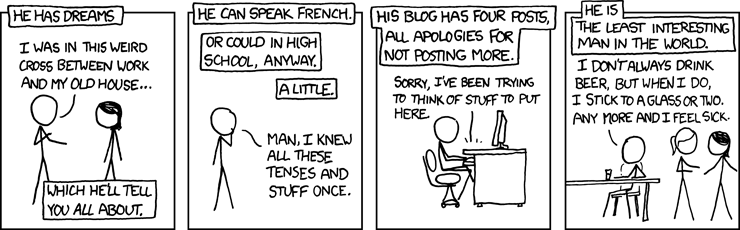
UPDATE 8/16/11 (i.e Months Later...): I'm relaunching this blog. The launch will be complete with regular posts! At least that's the plan. On writing this I can't help but think of a particular xkcd comic.


Let's hope I keep it somewhat interesting. Happy reading y'all!


Wednesday, August 11, 2010

What the &#*% is Transmedia: Before It Was Transmedia: Mephisto and Kevin

Although the word transmedia is fairly new, cross platform storytelling can be found in plenty of older properties. Every so often, I'll post up an old show or story on here that embodies this in what I hope will be an ongoing series of posts "Before It Was Transmedia". This time: South Park and the Primus song "Mephisto and Kevin" off the album "Chef Aid".

Written in 1998, the song tells the tale of the one of the significantly more obscure characters, Kevin aka "that little monkey guy". He never speaks on the show, except for a one time yelp in the episode "201". His character is never explained except as Mephisto's "son", the bizarre creature is a mystery to the casual fan but a dedicated fan will want to know just what the &#*% that little monkey guy is doing there.

Well, Primus (featuring Isaac Hayes) has the answer.

The song fills us in that Kevin is a genetically engineered pop star, born from Michael Jackson's sperm and an anonymous female singer's egg created by an old friend of Mephisto's. We even get to hear Kevin singing his song "I am Gopher Boy".

Personally, I love the song, it's a greatly humorous story with a catchy tune (Isaac Hayes even comments in the song about Kevin's tune being stuck in his head). From a storytelling perspective, what makes it great is that it manages to tell a very full story in five minutes and eighteen seconds.

The story works perfectly in this form because as much as this is a fun story, a full episode about a very tiny character like this will not play very well with the casual fans but it's a fun addition to the album they were putting out and fleshes out a minor mystery from the show.

So despite occurring years before anyone was really wondering what the &#*% transmedia was, this song is a perfect example of what transmedia can, and should, be.

Props: South Park is, of course, copyright property of Viacom and Comedy Central. If you'd like to purchase the song "Mephisto and Kevin" you can get the album "Chef Aid" on iTunes here or from Amazon here. You can check out South Park episodes free online (and legal!) here.

Wednesday, July 14, 2010

What the &#*% is Transmedia: Why Bother?

What is the point of transmedia? Why should anyone bother with stuff that's just on the Internet? It's not the actual show/movie/game so is there a point? Is it really doing anything positive for the show/movie/game?

I was recently luck enough to have lunch with an executive producer/writer on one of network TV's biggest shows (which I shall leave anonymous). We discussed new media and transmedia and he said, quite frankly, that he didn't think new media was worth the time and money.

I was shocked by the viewpoint if only in part because his show had recently expanded into the new media spectrum, though he chose to not be directly involved with the project. This, however, got me thinking about the bottom line reasons for transmedia. So, for today, let's ask why the %#*% we should do transmedia in the first place.

Transmedia focuses on the expansion of the mythos. The question after establishing that is simply why expanding the mythos is a good thing. After watching a movie or a TV show, Hollywood has already realized that people leave the theater or the living room wanting more (example: every unnecessary sequel ever made) and they don't want to wait for it. People hate waiting and we can take advantage of that.

Transmedia succeeds by fulfilling the fans natural desire for more as quickly as possible, sometimes even before hand. As soon as they can they get to their computer, they'll have the opportunity to jump into an extra piece of the story. This part is important because it establishes the franchise as a multi-platform experience from the get go. That way when you eventually expand further into the folds of the story, whether in book form, webisodes or whatever, they're ready and looking for it.

The goal is to keep their attention on the product for as long as possible. This is especially important on media that lives primarily on the web or another smaller market form. In this case, transmedia acts as a tool to keep the audience there.

Here's an example.

Let's say you're launching a new web series. The viewer of series #1 tunes in and watches the first episode. They enjoyed it but there's nothing else for them to look at so they click the next Youtube link and they're on to something else already. By the time the second episode launches, the viewer has forgotten about the series.

On the other hand, the viewer of series #2 watches their episode and then has the ability to read a short comic strip expanding the story of the episode just a bit. A tease for next week's episode. They've spent extra time with this series and got an extra amount of enjoyment out of it. That little extra time has taken them from going off and immediately diving into another series entirely. As long as the content is good, there's that much more chance for a return customer when episode 2 launches.

This can be the power of what transmedia does for a product. The extra content makes the experience wider and thus, more interesting. Bigger is not necessarily better and just having extra content is not enough. But if growing up a science fiction fan has taught me anything, it's that fanatics like more story and good story is what makes any media better than the competition.

Thursday, June 17, 2010

What the &#*% is Transmedia: Heroes of Transmedia – Beyond the Camera


   So you've watched every episode of Heroes and you've caught up with all of the webisodes but the problem is you still want more. Well good news: there is more. Heroes has taken advantage of many different forms of storytelling beyond the lens. A truly devoted Heroes fan can enjoy everything from graphic novels to a simple MMORPG (aka a Massive Multiplayer Online Role Playing Game for the less nerdy of you).

Graphic Novels
    One of the keys to any successful transmedia campaign (as it is for any piece of entertainment) is to know what your audience enjoys. Heroes is a show about superheroes and many of the themes are taken from comic books. Thus the natural train of thought is Heroes graphic novels.

    The 6-10 page graphic novels were released via the web from day one of the show and beyond the show's cancellation. A perfect companion piece, the novels allowed readers to get to know a great deal more about the universe of the show.
    Because of the fact that these stories were not limited to special effects budgets or actor availability or any of the other various issues that come up during filming, the writers (headed up during season four by staff writer Oliver Grigsby) were free to go in different directions with the stories. They could introduce significantly more complex powers (see Julien Dumont) and take characters to any part of the world that they wanted.

    During the fourth season, the graphic novels served the purpose of filling in stories of where characters had been while off screen, a question often raised on shows with so many interweaving plot lines. A perfect example of this is when Tracy disappears for several episodes, the graphic novel readers find out that she goes to work for Samuel hunting down an estranged carnival brother named Eli.

    Eli is an especially interesting case because the graphic novels are the first place he is actually introduced to fans. The dedicated fan is rewarded with a preview of things to come on the show. By rewarding fans in this way, NBC takes a big step in making sure that they can expect fans to come back again.

iStory
    A personal favorite (for very self involved reasons) is the Heroes iStory aka Interactive Story. Essentially, what these stories were akin to the choose-your-own-adventure Goosebumps novels. Players made choices on each page of the story as to where the characters would go or what they would do. Choices would lead you down different paths, each one affecting the outcome of the chapter.
    Conceptualized by digital writer Tom Inkel, these stories began during season three as a weekly game that fans could enjoy as an extension of what was happening on air and in the Heroes: Evolutions ARG. As readership grew, the iStory would begin involving webisode and even main characters from the show.
    Involving these characters meant that the stories could provide even more back story to on air events than was already being told via webisode and graphic novel. The real draw, however, of these stories was the interactive nature in which they were told. Since player's decisions affected the outcome, it gave the readers a feeling as if they were controlling what was happening on air.
    Each story offered several branches of each page, creating a huge amount of content for each story, as certain paths would reveal certain content and information, while other paths would give you something completely different. See the image left for an idea of how the story looks mapped out.
    During season four (the season in which I took over the iStory from Tom) the stories became directly tied to the show and webisodes (even carrying the same name, "Slow Burn"). Fans were introduced to the Bowmans, a family of firebreathers who had only recently joined up with Samuel's carnival. Stories were told from each of the perspectives (and occasionally both depending on which path was taken by the reader).
    Similar to the situation with Eli, these characters appeared on air several weeks after their introduction via the iStory. This gave the dedicated fans a fun, "oh look!" moment, when the Bowmans finally got there close ups.

(for more about the iStory, check out an interview with Tom Inkel at Heroes Wiki)

Heroes: Survival
    Everybody wants to have a superhero for a best friend right? Well with the online social networking game Heroes: Survival, fans got that chance. With space for a name, location, power description and bio, fans got the chance to create a hero that could live within the Heroes-verse. Helping characters in the iStory.

    An amazing example of fan interactivity, the game became a sort of Tamagotchi meets MMORPG. Fans would join factions, choose actions for their characters to do and lead their characters down heroic, villainous, neutral or reclusive paths.

     What made this game so much fun was that on many occasions during the summer and the fourth season, characters created by fans were directly incorporated into the iStory and on even a graphic novel.

    For example, during the Slow Burn iStory arc, Gail Bowman was sent on a mission to recruit specials for Samuel's carnival. She found a faction of people who called themselves The Guardians. This faction and some of the members who appeared in the story were created by a fan. To the right is a graphic created for the iStory of John Mulligan and the two player characters, Shard and Darkmoon.

    Now, if you're a fan of a show, what greater moment can you have besides having your character exist within the mythos of the show? With this promise out there, fans created thousands of characters and spent many hours (and many page visits) creating and maintaining their characters. A great amount of entertainment for these fans and direct involvement in the storytelling of the show.

Layering it All Together
    All of these things are fun and enjoyable on their own certainly, however what makes them work well is how they are integrated into each other and how the further down the chain you get the more of the big picture you start to form. Each layer reveals an extra piece of information that fills out the story you used to have and changes the experience in a positive way.
    Here is an example of the layering progression that could be found in season four as it built the character Amanda.
  • TV: Amanda is Lydia's daughter and they live at the carnival.
  • TV and webisodes: Lydia asked Amanda not to come to the carnival. She did anyway.
  • TV, webisodes and comics: Amanda left her home away from the carnival because she accidentally hurt her aunt with her ability, which she cannot control.
  • TV, webisodes, comics and iStory: Amanda gets help from Chris Bowman in controlling her ability.
  • TV, webisodes, comics, iStory and Heroes Survival Game: Amanda got help finding the carnival from fan created heroes.
     Adding some extra pieces to the puzzle doesn't make the it more complicated; it makes it bigger and more interesting, revealing new parts of the picture that you couldn't see before. Heroes' stories covered many forms of media platforms and storytelling devices, truly embracing the concept of transmedia.

The Thanks 
    In addition to everyone I thanked in the last post I would also like to thank Tom Inkel, Alexis Brandow, Abby Laspia, Jack Wei, Matt Neuenberg and Ryan Stewart all of whom worked tirelessly on the iStory and Heroes Survival Game.


NEXT TIME: Why bother with transmedia?